
Priority Rankings on LinkedIn: How They Work

You hit publish, share the post with your network, and then watch the feed go quiet. No comments, no fresh reach, no second wave from people you didn't directly ping. That silence usually isn't random, it's the result of priority rankings deciding whether your post deserves more distribution or gets left where it started.
For LinkedIn creators, that first stretch after publishing is where a post either gets a fair test or fades before the room has a chance to notice. The practical mistake is treating visibility like a reward for effort alone. The platform is closer to a filter, and the filter looks for the mix of relevance, attention, and interaction that tells it your post is worth widening.
Table of Contents
- The Silent Post Problem
- How Priority Rankings Work
- Key Signals That Drive Visibility
- Tuning Your Content for Better Rankings
- Real-World Examples of Ranking Success
- Common Misconceptions About Rankings
The Silent Post Problem
A post can feel strong and still stall. I've seen founders, consultants, and ghostwriters ship thoughtful content, share it once, and then assume the lack of response means the idea missed the mark. Often, the problem is narrower than that, the post didn't collect enough early signals to survive the first ranking pass.

The first hours matter because LinkedIn doesn't treat every post as equal baggage in the feed. It looks at how the first viewers respond, then decides whether the content should keep moving. That's why a good post can still feel invisible when the opening distribution is weak, and why a weakly matched post can briefly punch above its weight if the early audience reacts fast enough.
Why the first test matters
Priority rankings have a long history as a formal way to reconcile competing preferences, not a casual sorting trick. The modern web version of that idea shows up in feed distribution, where the platform tries to predict which posts should stay alive for a given audience and which should fade. NSW Health's research-priority guidance describes the same basic logic in another setting, items are ranked, points are allocated, and scores are aggregated into a final order, which is a useful reminder that the mechanics are about comparison, not guesswork NSW Health guidance on setting research priorities.
Practical rule: if a post doesn't earn attention early, the rest of the network may never see it.
That's where creators misread the silence. They keep refining the long-form idea when the issue is usually the opening distribution window. If you want a quick diagnostic, an analyzer like Linkboost's LinkedIn Post Analyzer can help you inspect the shape of a post before and after it goes live, so you're not guessing whether the hook or the audience match failed.
How Priority Rankings Work
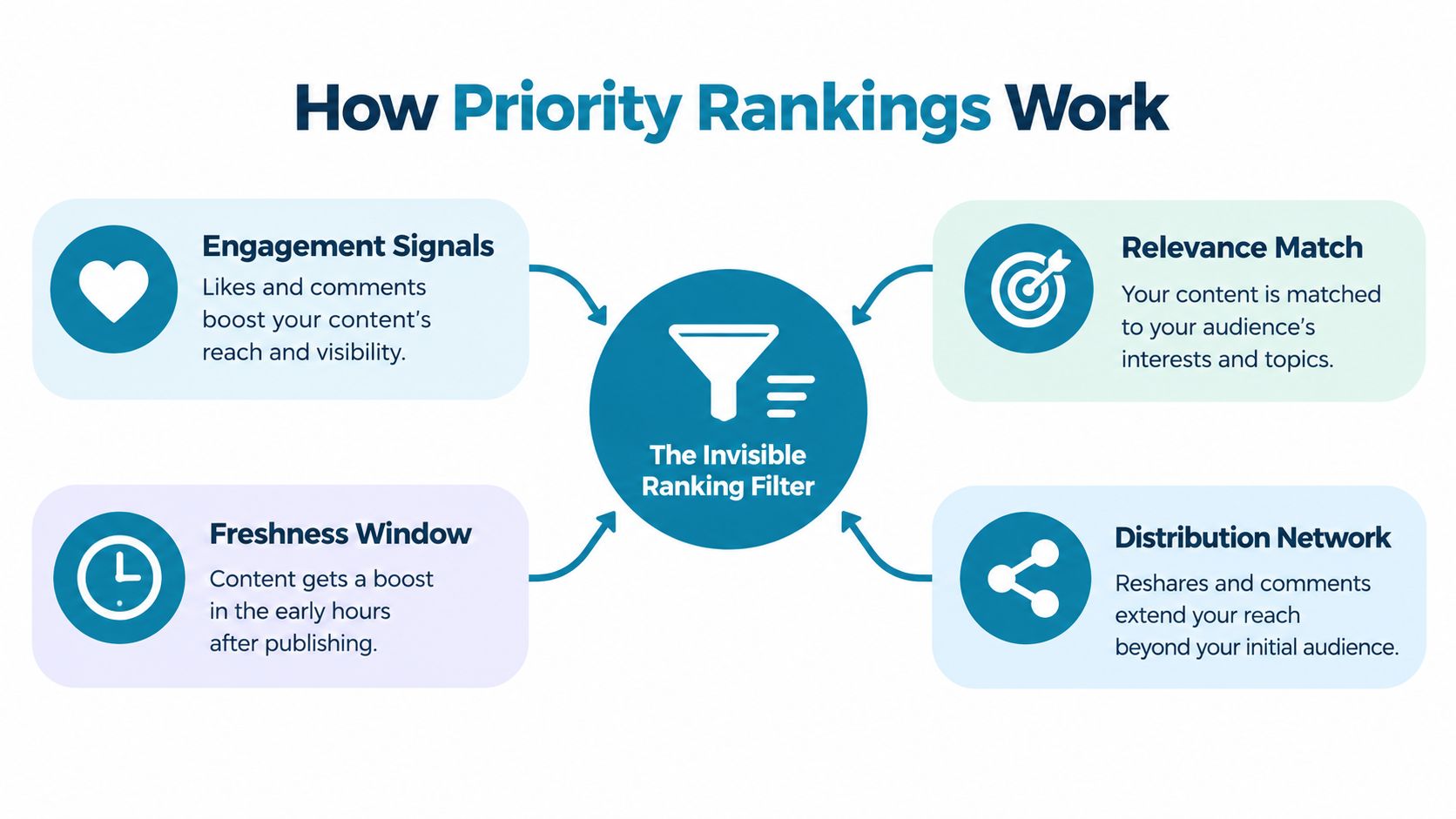
LinkedIn's ranking logic isn't public, but the working model is straightforward enough for practitioners. The system evaluates whether a post looks relevant to the viewer, whether it earns attention, and whether the interaction pattern suggests the content deserves broader distribution. In practice, that means a post isn't ranked once, it's re-evaluated as the audience responds.
A useful way to think about it is a simple hierarchy. Relevance gets the post in front of the right people. Engagement quality tells the platform whether those people actually care. Freshness gives the post its early window. Distribution behavior then determines whether the post keeps moving or tapers off.
The ranking logic in plain terms
The 2024 review of task multi-criteria prioritization methods shows that the field now groups approaches into full aggregation, inferiority ranking, reference-level methods, and data-processing-based prioritization, which tells you something important about modern ranking systems, they're built to balance multiple signals, not chase a single metric review of task multi-criteria prioritization methods. That's the same design pressure you feel on LinkedIn. One viewer's like is weak evidence. A cluster of relevant comments, saved posts, and longer reading time gives the system a cleaner signal.
If you're trying to tighten your content ops, Writingmate's practical roundup on ChatGPT SEO optimization tips is useful because it pushes the same discipline, write for the actual reader, not just for the output machine. That mindset translates well to LinkedIn, where the ranking system rewards content that matches intent and sustains attention.
What changes after the first reaction
Priority rankings are dynamic, not static. Once a post collects some response, the platform can expand, flatten, or narrow its distribution based on how that initial audience behaved. That's why one post with ordinary copy can travel if it lands cleanly with the right people, while another with sharper writing can stall if the audience fit is off.
The feed is not asking whether the post is interesting in the abstract, it's asking whether it's useful to this viewer right now.
That distinction matters. If you write a post that only performs when already seen by the right audience, the system may still bury it if the opening sample is too random. Matching topic, audience, and timing is what lets the ranker do its job.
Key Signals That Drive Visibility
The strongest ranking signals are the ones that prove people didn't just glance at your post, they stayed with it. Relevance is the starting point, because a post that misses the audience's professional context has to work much harder to earn any other signal. Once relevance is in place, attention and interaction determine whether the post deserves to keep circulating.
What to tune first
A practical order helps here:
- Topic fit first. Write for a named audience, not for “everyone on LinkedIn.” If the post feels generic, the system has fewer reasons to widen it.
- Reading depth second. Structure the post so people keep scrolling. Short blocks, tight transitions, and a clear payoff all help with dwell time.
- Intentional saves third. A save usually means the reader saw future value, which is different from a casual reaction.
- Thoughtful comments fourth. Comments that add context, disagree with substance, or expand the idea carry more weight than drive-by praise.
- Credibility fifth. If your profile and past posts make you look like a real voice on the subject, the new post starts with less friction.
For a useful performance lens, Linkboost's LinkedIn engagement rate calculator helps you compare posts by engagement quality instead of raw vanity numbers. That matters because a post can collect likes and still fail to signal depth.
Why saves and comments matter more than noise
Recent LinkedIn-algorithm coverage emphasizes relevance, expertise, dwell time, saves, and meaningful interaction over simple reaction counts, and it also notes that saves can carry significantly more weight than likes or comments in some interpretations of the ranking mix LinkedIn algorithm coverage. The practical takeaway is simple. A post that triggers real thinking can outrun a post that only triggers quick approval.
If you want better rankings, make the reader do something that reflects value. Ask for a comparison, a decision, or a counterpoint. Those prompts create responses that look like actual engagement, not empty motion.
Tuning Your Content for Better Rankings
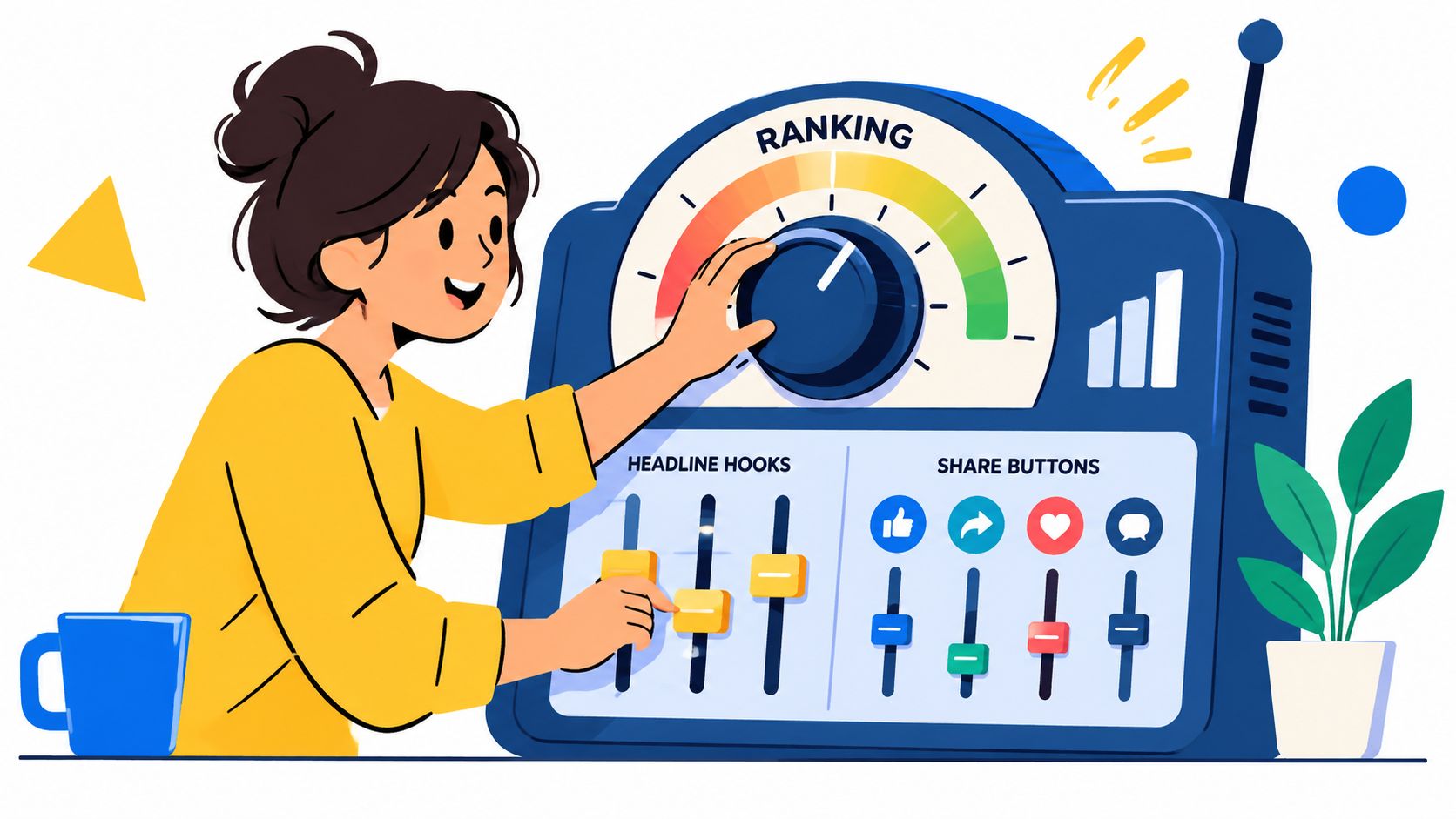
The fastest way to improve priority rankings is to remove friction from the first reading experience. Start with a hook that makes the right person feel seen immediately. If the opening line sounds like it could belong to any niche, it probably won't earn the kind of early response that keeps the post alive.
Build for attention, not decoration
The middle of the post matters just as much as the first line. Use spacing, short paragraphs, and a clean argument so readers don't bounce before they hit the point. If your post is a wall of text, you're asking the ranking system to carry a reading experience that the reader already rejected.
A practical structure looks like this:
- Lead with the problem. Name the friction your audience already feels.
- State the insight early. Don't bury the useful part under setup.
- Add one concrete payoff. Give the reader something they can use, compare, or question.
- Close with a prompt. Invite a response that takes thought, not just approval.
Using Linkboost's best time to post tool can help you align publishing with your audience's active window, which matters because early momentum is easier to build when people are already present. That doesn't fix weak topic fit, but it does reduce avoidable drag.
Early momentum helps, but it doesn't rescue weak content
That's where a lot of teams overcorrect. Coordinated first-hour likes and comments can help a post clear the initial test, especially when the people engaging are aligned with the topic and the network. Linkboost, for example, coordinates LinkedIn engagement by combining vetted pods, early likes, and AI-generated comments in the first hour after publishing, which is a direct response to the early silence problem.
The trade-off is real. If the content is off-topic, shallow, or mismatched to the audience, the boost buys only a small window of visibility. The ranking system still looks for attention quality after the initial push.
Practical rule: use early engagement to support a post that already deserves distribution, not to disguise one that doesn't.
Real-World Examples of Ranking Success
A post usually gains traction when content quality and distribution discipline work together. I've seen a sharp case study outperform a generic announcement because it gave readers a clear problem, a specific process, and a takeaway they could use. That kind of post keeps people reading, and the conversation in the comments can add another layer of relevance.
Two paths that look similar at launch
A marketing consultant and a founder can publish on the same day and get very different results. The consultant may create early activity in the first hour so the post does not sit in silence, while the founder may rely on the strength of the content to earn saves and comments over time. Both can work, but the inputs are different.
The early-engagement path helps when the topic is timely, the audience is narrow, and the post needs a visible start. The depth-first path works when the topic already has pull and the author has enough trust for people to stay with the post without outside help. In practice, I trust the second path more when the post needs credibility more than speed.
When each approach wins
- Early engagement wins when the audience is cold. If the post needs proof of life, coordinated first-hour interaction can keep it from disappearing before real readers arrive.
- Sustained relevance wins when the topic is strong. A post that solves a real problem can keep earning distribution even without a heavy launch.
- The mix wins when you have both. Strong topic fit plus clean early activity gives the ranking system better evidence to extend reach.
That same pattern shows up in ranking work outside LinkedIn. The Cambridge study on protected-area prioritization found that different ranking methods can converge when they are driven by the same underlying signals, with unweighted-average and PCA-derived ranks strongly correlated, and Markov chain and PageRank-based ranks also strongly correlated Cambridge study on protected-area prioritization. In plain language, different paths can lead to similar outcomes when the inputs line up.
For LinkedIn, the practical lesson is simple. A launch boost can help a good post get seen sooner, but it cannot fix weak topic fit. A post built around a real professional problem can survive a slower start. A post built around vanity usually cannot survive at all.
Common Misconceptions About Rankings
A lot of wasted effort comes from treating priority rankings like a single trick. The biggest myth is that timing alone solves everything. Timing matters, but only because it shapes the first engagement window, and that window only helps if the post is relevant enough to keep people reading.
What creators often get wrong
Another common mistake is chasing raw likes. Likes are useful, but they're a shallow signal on their own. If the post doesn't earn saves, thoughtful replies, or enough reading depth to hold attention, the ranking lift is usually fragile.
Some creators also assume coordinated engagement is the same as artificial inflation. That misses the point. A well-run early engagement push is best understood as distribution support, not a substitute for value. It helps the post reach the threshold where the system can judge it fairly, especially when the first audience is too small or too random.
Early momentum is a signal amplifier, not a content replacement.
The other misconception is that expertise is only a profile issue. On LinkedIn, expertise is also post-level behavior. If you consistently write with a clear point of view, use the language of the niche, and answer comments with substance, the platform has more reason to classify your work as credible.
A better way to think about the trade-off
The tension is between first-hour momentum and deeper ranking signals like relevance and dwell time. Early likes and comments can help a post get seen, but they won't save a weak topic fit or low reading depth. On the other hand, a highly relevant post can sometimes overcome a quiet launch because the reader behavior becomes strong enough to carry it forward.
That's why the best operators don't obsess over one signal. They pair a clean publishing cadence, a topic their audience wants, and a distribution routine that gives the post a fair start. Priority rankings reward that balance more than any single gimmick.
If you want LinkedIn posts to stop dying in the first hour, Linkboost gives you a structured way to coordinate early engagement, AI-written comments, and pod activity around that critical window. Visit Linkboost to see how it fits into a distribution workflow that supports, rather than substitutes for, strong content.