
LinkedIn Pod Management: Step-by-Step Guide for 2026

Early engagement is often treated as a race to collect as many likes and comments as possible. That advice is incomplete, and in 2026 it can be actively dangerous. The useful question isn't whether engagement pods work in isolation. It's whether the attention they create is relevant, diverse, and sustainable after LinkedIn evaluates the interaction pattern.
Pod management is no longer a volume tactic. It's governance. You're managing a distribution asset with a measurable upside, a finite attention budget, and a real risk of suppressing the very content you're trying to promote. The operators who succeed will control membership, interaction quality, timing, moderation, and recovery instead of outsourcing judgment to automation.
Table of Contents
- Redefining Pod Management for the Modern Algorithm
- Finding and Selecting the Right Engagement Pods
- Automation Workflows and Coordination Strategies
- Moderation Controls and Quality Management
- Measuring Performance and Optimizing Results
- Navigating Algorithm Risks and Recovery Protocols
Redefining Pod Management for the Modern Algorithm
The binary argument, “pods work” versus “pods fail,” misses the operational issue. A pod can create useful early activity and still damage a profile if members leave repetitive comments, engage without reading, or coordinate so predictably that the activity looks artificial. The outcome depends less on the existence of a pod than on how carefully you govern it.
A large LinkedIn analysis illustrates the attraction. Across 290,032 posts, posts receiving their first engagement within five minutes averaged 17,692 impressions, compared with 6,422 impressions for posts whose first engagement arrived after 60 or more minutes. That created a 2.75x gap. The same analysis reported total engagements of 67.02 with coordinated auto-engagement, compared with 52.80 without it, a 27% lift. These figures show why creators keep pursuing early momentum, but they don't prove that every form of coordination is safe or valuable. The full LinkedIn engagement analysis is useful precisely because it exposes both the upside and the temptation to optimize for surface activity.

Treat the pod as a governed network
A managed pod needs a purpose. That purpose might be helping subject-matter experts get their posts in front of relevant peers, giving founders access to informed discussion, or creating a reliable source of early feedback. “More engagement” isn't a purpose. It's an output that only matters when it improves distribution, conversation quality, profile visits, or business relevance.
Set operating rules before you invite members:
- Define the audience: Keep members close enough in topic, seniority, or buyer relevance that their responses make sense.
- Set a quality threshold: A short comment can be valuable, but generic praise, recycled phrasing, and empty emoji replies should be rejected.
- Require selective participation: Members shouldn't feel obliged to engage with every post. Irrelevant participation creates the pattern you're trying to avoid.
- Review outcomes: Measure whether pod activity attracts meaningful reactions from outside the pod, not only whether members completed their actions.
Independent coverage referenced in the 2026 algorithm discussion says LinkedIn detects reciprocal engagement, comment velocity, repetitive network patterns, and artificial engagement practices. The same coverage notes that LinkedIn has continued to state it takes action against artificial engagement, including engagement pods and automated commenting tools. The algorithm overview from SocialPilot provides the relevant context, but the practical conclusion is yours to make: a pod should support credible distribution, not manufacture the appearance of popularity.
Practical rule: If you can't explain why a member's comment belongs under the post, the interaction probably shouldn't happen.
Finding and Selecting the Right Engagement Pods
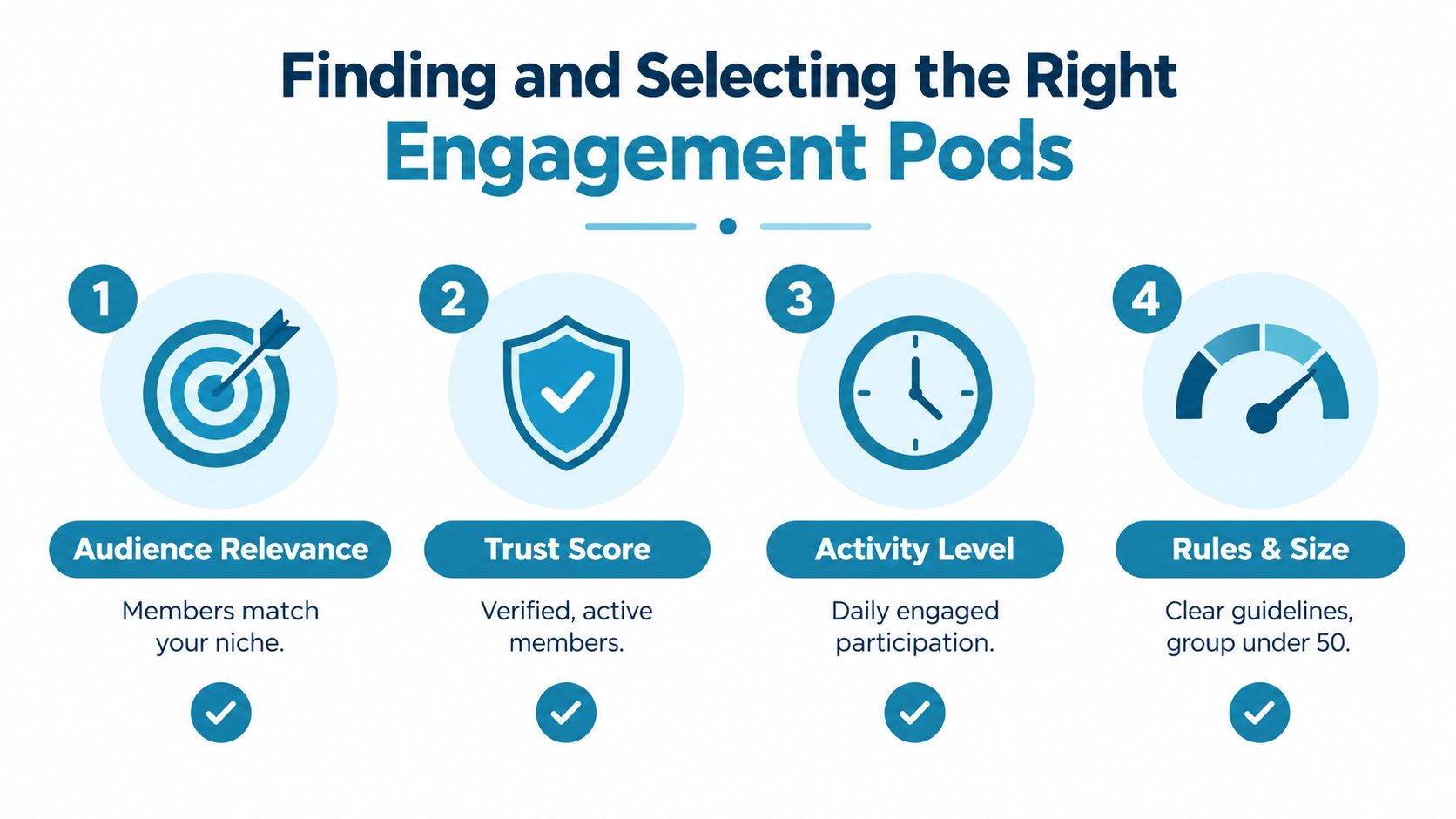
Pod management starts before the first invitation. Joining a large group because it promises fast activity is lazy targeting. You need to assess the people, the conversation, and the operating discipline.
Start with audience relevance
Review recent posts from potential members. Look for shared subject areas, complementary expertise, and genuine overlap in the people you want to reach. A cybersecurity consultant, a technical founder, and a B2B security buyer may form a useful specialist pod. A mixed group built only around follower counts usually produces shallow replies and weak secondary reach.
Use a simple selection process:
- Inspect the member mix. Check whether people publish about the same market, adjacent problems, or a compatible professional audience. Relevance matters more than raw membership.
- Read the comments. Look for specific observations, follow-up questions, and references to the post itself. If the visible engagement consists of identical compliments, leave.
- Ask about participation rules. A credible administrator should explain how members submit posts, how irrelevant content is handled, and what happens when someone repeatedly contributes low-quality comments.
- Test the workflow before committing. Join with a limited set of posts and observe whether the group produces thoughtful discussion or merely checks an engagement box.
Choose specialization over broad reach
Broad pods can expose a post to more varied networks, but that reach often comes with weaker context. Specialized pods usually offer fewer irrelevant interactions and a better chance that members can add substance. Choose the specialized option when your priority is authority, qualified profile visits, or conversations with practitioners.
A broader group can make sense for general professional content, career commentary, or a creator testing new themes. Even then, don't confuse a wide network with a relevant network. The right question is, “Would these people naturally respond to this post if they discovered it in their feed?”
Your setup should also include a clear exit condition. Leave a pod when members ignore the topic, submit repetitive content, or pressure participants to engage indiscriminately. If you're comparing tools that help identify alternatives to browser-based pod workflows, review this alternative to Lempod as part of your evaluation, then judge any platform by its controls and interaction quality rather than its promise of effortless scale.
Automation Workflows and Coordination Strategies
Automation solves coordination friction, not strategy. It can remind members to participate, route posts to the right people, and reduce the manual work of checking group chats. It can't determine whether a comment is insightful, whether the member is relevant, or whether the overall interaction pattern looks natural.
The operating choice usually falls into three models:
| Workflow Type | Coordination Effort | Comment Authenticity | Scale Capacity |
|---|---|---|---|
| Manual coordination | High, because members submit and review posts themselves | Potentially high when members read carefully | Limited by attention and response time |
| Browser-based automation | Lower at the surface, but requires account and extension oversight | Variable, especially with templates or rushed replies | Moderate, with added operational risk |
| Server-side, rate-limited workflow | Lower for scheduling and routing | Strong when comments are reviewed and context-aware | Higher, provided quality controls stay active |
Manual workflows suit high-stakes content
Use manual coordination for founder announcements, sensitive opinions, research findings, and posts tied directly to sales conversations. Ask members to read the full post, identify one specific idea, and respond in their own language. The process takes longer, but it protects the relationship between the author and the commenter.
A useful manual brief includes the post link, the audience it targets, the type of response wanted, and an instruction to disagree when appropriate. That last point matters. Uniform approval looks less credible than a mix of questions, clarifications, examples, and respectful challenges.
Automation works best as controlled routing
For repeatable content, a managed workflow can handle submission, notification, audience matching, and timing. Server-side operation with spaced, rate-limited interactions is operationally different from a browser extension that acts through a user's active session. Neither approach removes the need for governance, but the former gives an administrator more room to inspect activity and impose controls.
AI-generated comments need the same scrutiny as human comments. Give the system the post context and your preferred voice, then edit anything vague, overconfident, or disconnected from the argument. Never accept a comment because it arrived quickly.
Early engagement should create a credible conversation, not a synchronized burst of praise.
Use a Smart Feed to prioritize posts from relevant members, and use discovery tools to find discussions where your contribution has a real reason to exist. Timing matters, but timing without relevance is just faster noise. The strongest workflow combines a quick first review, selective participation, and a later check of whether the conversation continued beyond the pod.
Moderation Controls and Quality Management
A pod degrades when its administrator treats every member as equally valuable forever. People change topics, stop participating, reuse comments, or begin submitting promotional posts that don't fit the group. Moderation isn't an administrative detail. It's the mechanism that protects the network's usefulness.
Establish rules that moderators can enforce
Write rules in observable terms. “Be authentic” is too vague to moderate. “Mention a specific point from the post, add a relevant example, or ask a genuine question” gives members a standard they can follow and moderators can assess.
Use a short operating policy covering:
- Eligible posts: Define the topics, formats, and professional contexts the pod supports.
- Comment standards: Reject generic praise, copied phrasing, irrelevant links, and comments that make claims the writer can't support.
- Participation expectations: Make it clear that members can skip posts outside their expertise.
- Escalation steps: Start with a private warning, then restrict participation, then remove the member if the pattern continues.

Use blocklists and reporting deliberately
Blocklists should protect the pod from accounts that repeatedly submit unsuitable content, scrape member information, or ignore moderation decisions. Bans should be based on behavior, not personal disagreement. A member who offers a thoughtful opposing view is contributing. A member who pastes the same promotional reply across unrelated posts is not.
Create a feedback loop. Record why content was rejected, which members receive warnings, and which discussions produce useful participation. Administrators can then distinguish an isolated mistake from a quality trend. Tools for PostSyncer community management can help teams formalize member oversight, but the policy still needs a human owner who understands the community's purpose.
Use post analysis to identify recurring problems. An analyzer for LinkedIn posts can support review of content performance, but don't let a dashboard replace moderation judgment. A post may underperform because the idea is weak, the audience is wrong, or the discussion lacks substance. Those require different interventions.
A clean pod is smaller in spirit, even when its member list is large. Every participant should make the conversation more useful.
Measuring Performance and Optimizing Results
Pod management without measurement becomes ritual. You need to separate the activity generated by the pod from the outcomes that matter to the account. Likes and comments are visible, but they aren't enough to justify continued participation.
Read post-level signals together
Track impressions, reactions, comments, profile activity, clicks where available, and the quality of replies. Compare each post with your own normal performance rather than declaring success from a single high number. A post with substantial activity but no relevant discussion may be less useful than a quieter post that attracts the right professionals.
The strongest diagnosis combines timing and composition:
- Early activity: Did relevant people respond soon after publication?
- Comment substance: Did replies reference the argument, add experience, or invite a useful answer?
- External participation: Did people outside the pod join the discussion?
- Profile relevance: Did the post attract visitors who match your professional audience?
- Content fit: Did the topic itself deserve distribution, or did the pod only inflate a weak idea?
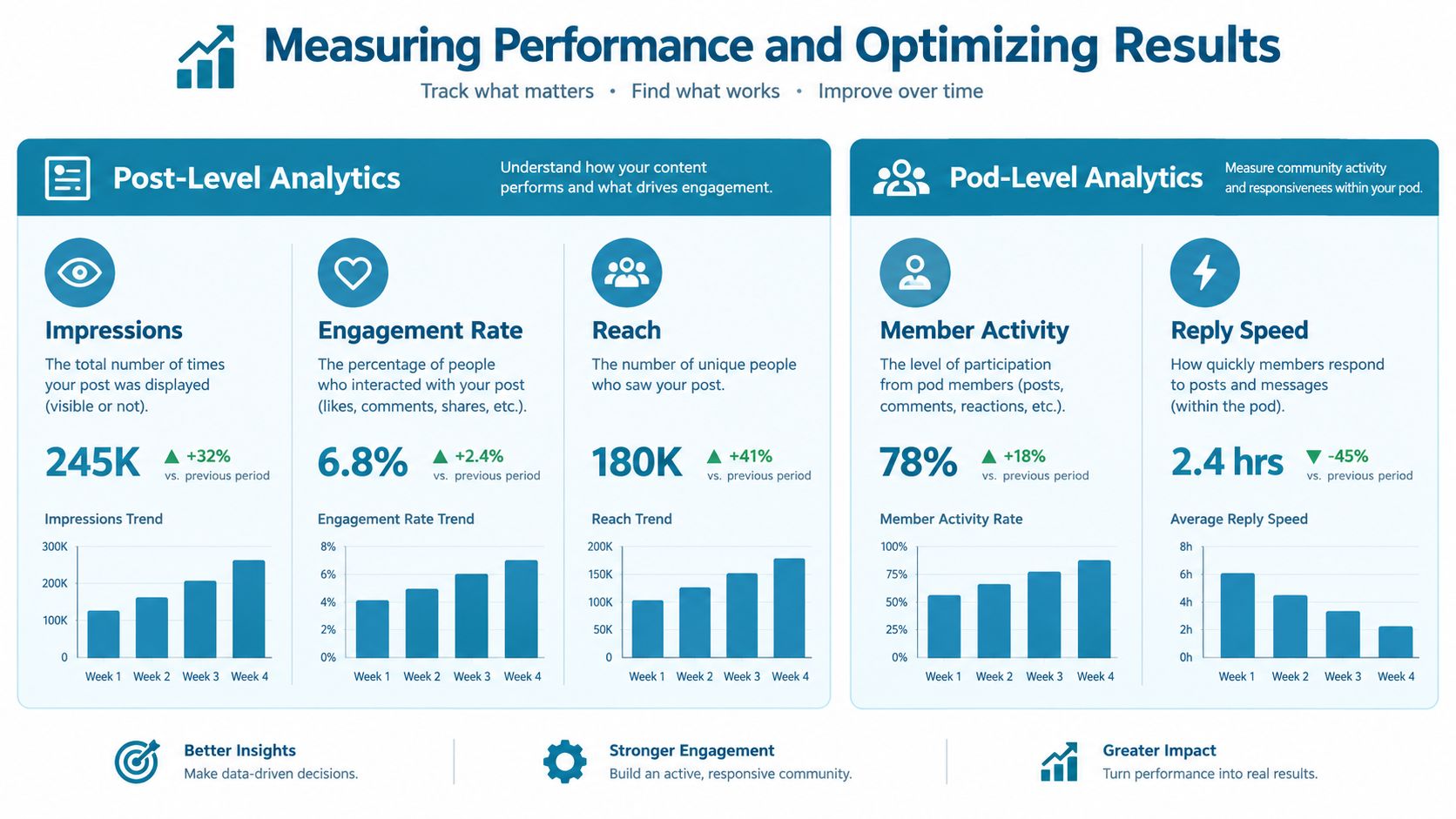
A useful reference such as Captapi's social media engagement metrics guide can help standardize definitions across a content team. Keep the reporting language consistent, especially when several people manage the same profile.
Treat pod-level data as a portfolio decision
Evaluate pods against one another. One group may produce thoughtful comments from a narrow professional audience, while another creates quick activity from people who never engage again. The second pod may look busier and still be less valuable.
Run controlled comparisons by changing one input at a time. Use similar content themes, compare different member groups, and review results over enough posts to identify a pattern. Don't change the pod, posting time, topic, format, and comment style simultaneously, or you won't know what caused the outcome.
Use an engagement-rate calculator such as this LinkedIn engagement rate calculator to keep calculations consistent, but interpret the result alongside comment quality and audience fit. A ratio can describe activity. It can't tell you whether the activity came from future customers, peers, or a closed loop of reciprocal participants.
One dataset reported a sharp downside for pod-boosted posts. In an analysis of 52,847 LinkedIn posts from B2B founders, those posts had 43% lower organic reach after the first 24 hours, 61% fewer meaningful comments from target prospects, 28% lower click-through rates to external content, and 52% less profile traffic. The analysis reported that the suppression effect lasted 7 to 14 days per flagged post. The underlying report on engagement pods makes the business implication clear: a pod that improves the first visible burst while weakening later distribution is not performing well.
Navigating Algorithm Risks and Recovery Protocols
The assumption that first-hour coordination is always beneficial is the wrong one. Early engagement can help distribution, but artificial or repetitive interaction can create a liability that outlasts the post itself. Your job is to identify whether the activity looks like a genuine response from relevant people or a predictable exchange among the same accounts.
Watch for warning signs at the account level:
- Distribution changes: Similar posts receive noticeably weaker organic participation after coordinated activity.
- Audience mismatch: Engagement rises, but relevant prospects and peers stop appearing in the discussion.
- Repetitive participation: The same members interact in the same sequence, with similar wording and timing.
- Post-level inconsistency: A post receives a sudden burst but fails to generate continued conversation or profile interest.
Don't respond by adding more automation. Pause the questionable workflow, stop using the members or pods associated with the pattern, and review recent posts for repetitive comments. Remove low-quality replies where appropriate, return to genuinely relevant conversations, and publish content that can stand on its own without coordinated support.
Build a recovery protocol
Start with diagnosis, not panic. Compare recent posts with your normal baseline, inspect who is engaging, and identify whether the problem is limited to one pod or appears across the account. Keep a record of the change so you can judge whether the account recovers after the behavior stops.
Then rebuild trust through ordinary participation:
- Suspend questionable coordination. Don't keep testing a pattern that may already be harming distribution.
- Prioritize direct expertise. Comment on posts you discovered naturally and add information you can defend.
- Reduce repetitive behavior. Vary topics, contributors, response formats, and participation choices.
- Review each post manually. Confirm that early replies are relevant before they go live.
- Resume selectively, if at all. Only reintroduce structured engagement after the account's distribution and audience quality stabilize.
The evidence supports a contrarian operating principle. The question isn't whether a pod can produce early activity. It's what kind of early engagement survives detection, and whether the distribution benefit comes from timing, the relevance of the participants, or the pod mechanism itself. If you can't separate those variables, you can't manage the risk responsibly.
Linkboost coordinates LinkedIn engagement through vetted pods, AI-assisted comments, discovery workflows, Smart Feed, and post-level and pod-level analytics, with moderation controls for blocklists, bans, and reporting. If you want to replace improvised group chats with a governed workflow for relevant early engagement, visit Linkboost and evaluate whether its controls fit your distribution strategy.