
7 LinkedIn Engagement Pods Groups to Know

What kind of LinkedIn engagement group fits your workflow? A creator community, a vetted industry pod, a sales network, and an agency-managed system may all be called LinkedIn engagement pods groups, but they don't solve the same problem. Each has different expectations around audience relevance, first-hour timing, comment quality, moderation, workload, and measurable outcomes.
A pod is a coordinated group whose members engage with one another's posts, usually soon after publication, to help create early visibility. LinkedIn publishing had already described pods as private groups or message threads by 2018, where members regularly interacted with each other's content to amplify reach, as documented in this overview of LinkedIn engagement pods. The useful question today isn't whether pods work. It's whether the people, comments, and operating rules fit the audience you're trying to reach.
This list moves from broad creator communities to specialized models for demand generation, sales, industry authority, agencies, and newsletters. Use it to choose a structure that supports relevant, authentic participation and responsible platform use, rather than chasing raw activity. For wider context, audience engagement in social media is a useful lens for separating visible interaction from meaningful audience response.
Table of Contents
- 1. LinkedIn Creators Community Official LinkedIn
- 2. The Engagement Accelerator Demand Gen And Content Pods
- 3. Creator Network Communities On Facebook And Slack
- 4. LinkedIn Sales Navigator And Sales Engagement Communities
- 5. Industry-Specific Slack And Discord Pod Networks
- 6. Agency And Ghostwriting Pod Networks
- 7. Niche Community And Substack Newsletter Pod Networks
- 7-Point Comparison: LinkedIn Engagement Pods & Groups
- Choose The Pod Structure You Can Sustain
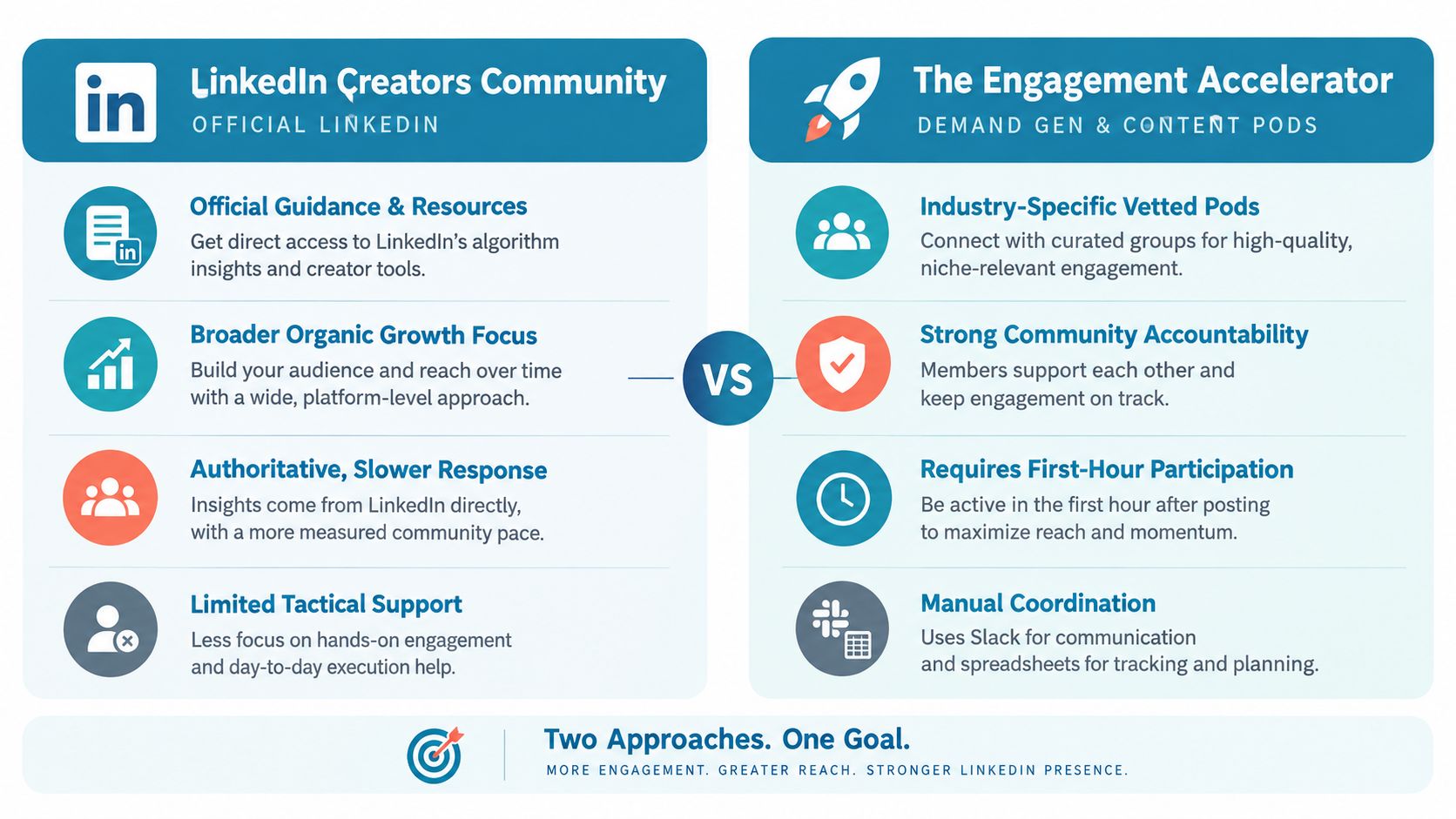
1. LinkedIn Creators Community Official LinkedIn
An official LinkedIn creator community is the broadest structure in this list. It suits publishers, independent creators, and content teams that want platform-aligned guidance before committing to a private engagement pod. The emphasis is usually on learning how distribution works, discussing formats, and exchanging practical observations with other people who publish regularly.
This model is less about guaranteed reciprocal activity and more about improving the quality of the system around your content. A creator might ask peers whether a document post, text post, or newsletter promotion is appropriate for a particular objective. A marketing team might use community feedback to refine its editorial calendar. A publisher may watch discussions for changes in how early engagement, comments, and audience signals affect distribution.
LinkedIn content distribution appears to be heavily front-loaded. Independent summaries of large-scale post analyses describe the first 60 to 90 minutes as a key early window, with one summary reporting that LinkedIn may initially show a post to roughly 2% to 5% of a creator's network and that this period can account for about 70% of total reach. Those figures come from industry reporting on LinkedIn content statistics, so treat them as directional rather than a promise for every account.
Best operating model
Use this community when your priority is platform literacy, content feedback, and sustainable publishing habits. Pair official guidance with your own analytics, then test whether early responses come from people who understand your subject and could plausibly become part of your audience.
A practical workflow is:
- Ask for critique first: Validate a post's clarity and relevance before seeking amplification.
- Share observations: Bring anonymized early engagement patterns to discussions and compare them with peers.
- Watch for changes: Review official announcements and creator guidance before changing your operating rules.
- Measure beyond likes: Track meaningful comments, profile visits, clicks, and replies.
For creators who need a more structured way to assess profile positioning while learning, the LinkedIn SSI score estimator can sit alongside qualitative community feedback. It shouldn't replace audience research, but it can help identify whether your profile supports the authority your content is trying to build.
2. The Engagement Accelerator Demand Gen And Content Pods
A demand-generation pod is narrower and more operational than a broad creator community. Members are grouped around related B2B themes such as SaaS, marketing, technology, or sales, and they agree to review and respond to one another's posts within an early publishing window. The value depends on theme matching. A thoughtful comment from a relevant operator is more useful than a fast reaction from someone who has no connection to the topic.
This model can fit founders building category authority, B2B marketers distributing research, and agencies coordinating client thought leadership. It also creates a real coordination burden. Members need to monitor post alerts, read the content, contribute something relevant, and reciprocate consistently. If participants only appear when they need amplification, trust deteriorates quickly.
Recent independent analysis shows why quality and downstream measurement matter. A 2026 review of more than 50,000 posts reported that posts using engagement pods experienced 43% lower organic reach after the first 24 hours, 61% fewer meaningful comments from target prospects, 28% lower click-through rates, and 52% less profile traffic, with the reported penalty lasting 7 to 14 days per flagged post. The findings are detailed in the 2026 review of LinkedIn engagement pods.
Best operating model
Choose this structure only when members share a credible relationship to the subject matter. Start with a small number of tightly matched groups rather than joining every available pod. Define the response window, minimum comment standard, moderation process, and exit conditions before posting.
Use a LinkedIn engagement rate calculator to compare posts by audience response, not just by the amount of coordinated activity. A successful demand-generation pod should help you learn which topics attract relevant discussion and business attention. If it produces a temporary spike but no qualified conversation, it may be distributing activity without improving demand.
Practical rule: A pod should make your content more discoverable to the right people, not merely more active to the same people.
3. Creator Network Communities On Facebook And Slack
Creator networks on Facebook, Slack, or Discord are flexible and informal. They often combine peer advice, content reviews, live coordination, and occasional engagement challenges. Unlike a tightly governed pod, a broad creator network may let members find their own partners and create smaller working groups inside the larger community.
That flexibility works well for solopreneurs and early-stage creators who don't yet know which audience or format will become their focus. A freelance strategist might meet a newsletter writer whose readers overlap with their own. A small content team might exchange post drafts and create a private channel for coordinated discussion. These relationships can become more valuable than the original engagement arrangement because members learn each other's expertise and communication style.
The trade-off is inconsistency. Large communities can become noisy, and response expectations may be unclear. One person may treat a comment swap as a serious editorial commitment, while another may leave short reactions whenever they have spare time. Without written standards, the group gradually rewards speed over thoughtfulness.
Best operating model
Use a broad network for discovery, then move reliable collaborators into a smaller private group. Agree on:
- Response timing: Decide how quickly members should review a post after it is shared.
- Comment quality: Require a specific observation, useful question, or relevant experience.
- Participation limits: Keep the group small enough that members can read posts properly.
- Review points: Reassess whether the group is creating useful conversations rather than repetitive activity.
A Slack channel can work well for coordination, but the channel should not become a link-dumping queue. Members need enough context to understand the post and decide whether they can contribute meaningfully. Share analytics openly, including posts that failed, so partners can help improve the content rather than only inflate its visible activity.
For a solopreneur, the right creator network may be the one that produces fewer comments but better relationships. For an agency team, it may be a discovery layer for finding specialists before inviting them into a more accountable operating model.
4. LinkedIn Sales Navigator And Sales Engagement Communities
Sales-focused communities operate around authority, buyer relevance, and useful commercial discussion. Members may include founders, SDRs, sales leaders, consultants, and revenue operators who publish about prospecting, sales methods, leadership, or customer problems. Their operating model should be selective: respond when a member has a credible point of view, not because every post needs a reaction.
Audience fit determines the value of the group. A sales consultant can test whether a post addresses a genuine buyer concern. An SDR team can coordinate informed responses to a leader's analysis of a sales process. A revenue executive can build relationships with peers who understand the same commercial pressures. Shared verticals, buyer segments, or working environments usually produce more useful exchanges than broad membership.
The coordination burden is moderate. A group needs a clear way to share posts, set response expectations, and identify who can contribute without forcing participation. Accountability also matters. Members should explain why a discussion is relevant to their audience and review whether comments add context, evidence, or a practical question.
The main risk is treating professional engagement like prospecting automation. Peer comments can strengthen credibility, but they do not replace direct research, relevant outreach, or a useful follow-up conversation. Keep product pitches out of routine discussion. Buyers quickly notice engagement designed only to redirect attention to a seller.
Choose a community based on the market you serve, then judge it by outcomes rather than activity. A SaaS sales group may suit an account executive but offer little value to a consultant serving public-sector organizations. Track Audience relevance by checking whether responders resemble the people you want to influence. Assess Conversation quality through questions, specific observations, and extended arguments. Watch Profile behavior from relevant visitors or followers, and record Pipeline influence when content supports a later conversation, meeting, or opportunity.
Keep notes on which subjects attract buyers, peers, and potential partners. Fewer interactions can indicate stronger commercial value when the discussion reaches the right decision-makers. Sales communities work when they reinforce a credible point of view. They fail when members create social proof around content that offers little help to the audience.
5. Industry-Specific Slack And Discord Pod Networks
What should a specialist gain from a private Slack or Discord pod that a broad creator group cannot provide? The answer is context. Industry networks bring together people who understand the terminology, constraints, buyers, and reputational risks of a field. Examples include marketing pods, technology founder groups, fintech communities, and HR networks.
Their primary operating model is peer review, with optional coordinated engagement. Product marketing leaders can test a go-to-market argument before publishing it. Fintech founders can discuss a regulatory development. Technical executives can check whether a claim is accurate, useful, and clear to practitioners. These exchanges can improve a post even when members do not organize a public commenting wave.
The audience fit is strongest for specialists seeking credibility with peers, partners, or informed buyers. A technical founder may get useful objections from engineers, while a sales leader may refine a point of view with other operators. A general creator seeking fast reach will usually find the smaller audience less suitable.
Coordination should stay light. Use a channel for draft reviews, a separate thread for published posts, and a clear request format stating the feedback needed. Members can choose whether a post merits public engagement rather than treating every submission as an obligation.
Accountability depends on reputation and contribution. Protect confidentiality by keeping client, employer, and customer information out of public threads unless permission exists. Reward expertise by favoring comments with evidence, context, or a useful counterpoint. Moderate consistently when participation becomes repetitive, promotional, or off-topic. Share the benefit through discussions that help the whole community, rather than serving one author.
Invitation, referral, or approval requirements reduce access but help preserve trust. Track whether feedback improves clarity, attracts relevant profile visits, or starts credible conversations. A smaller network works when members contribute judgment, not just activity.
6. Agency And Ghostwriting Pod Networks
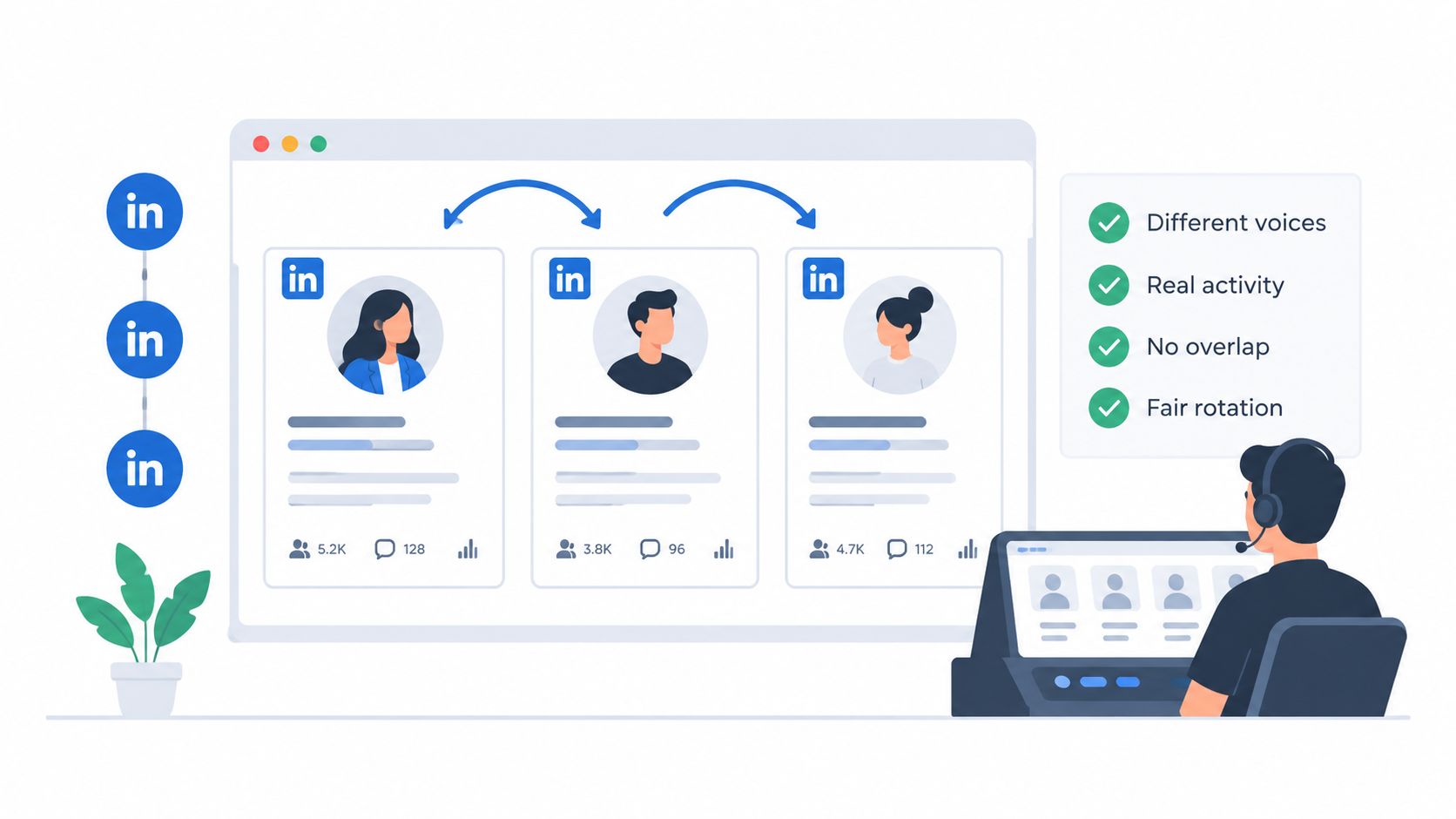
How can an agency coordinate engagement across several client profiles without making every account sound the same? Agency and ghostwriting networks require operating rules because one team may manage founders, executives, and company pages with different voices, audiences, approval paths, and commercial goals.
This structure fits agencies, ghostwriters, and sales teams supporting multiple experts. Its audience fit comes from shared workflow rather than shared industry. A pod can distribute attention across accounts, but it also creates coordination costs. Staff must know which post is approved, who owns the response, when participation is useful, and whether a comment matches the account's expertise.
Separate client work before anyone engages. Use account-level tags, approval states, and rotation rules so a team can identify the next priority without exposing one client's information to another. Each post should have an owner, an approved voice, and a response window. A ghostwriter can draft a comment for an executive, but the executive's perspective must remain recognizable and relevant to the original post.
Use these controls in the workflow:
Voice controls: Keep examples of approved language, expertise boundaries, and prohibited claims for each account.
Approval timing: Pre-approve recurring formats, while sending sensitive or technical posts for individual review.
Fair allocation: Rotate engagement support across clients instead of allowing the fastest publisher to receive all available attention.
Client reporting: Report outcomes by profile. A combined engagement total can hide whether any account is reaching the right people.
Human review: Inspect drafted or generated comments before publication when brand or reputation risk is high.
Comment quality needs its own check. Remove replies that merely praise the author, repeat a talking point, or sound interchangeable across clients. Retain comments that add a relevant example, clarify a position, or invite a useful response. That standard takes more time than automated participation, so agencies should set a realistic number of accounts per coordinator.
Measure the outcome against each client's goal. One profile may need qualified profile visits, while another may seek newsletter interest, partner conversations, or sales influence. For profile experiments, a LinkedIn headline generator can support draft variations, but the final wording should reflect the client's positioning and actual expertise. Tools reduce repetitive work. They cannot decide what an executive can credibly represent.
7. Niche Community And Substack Newsletter Pod Networks
What should a newsletter pod produce besides a temporary rise in LinkedIn reactions?
Niche creator networks organize around a subject such as AI, remote work, personal finance, recruiting, or another defined field. Members share LinkedIn posts that support a newsletter or independent publication, so the operating model connects social distribution with a longer publishing cycle. Shared expertise improves audience fit, but participation still requires coordination. Members must read the post, understand its context, and respond within an agreed window.
This structure suits independent writers, analysts, and subject-matter experts who value subscriber quality over broad feed visibility. A newsletter writer might ask peers whether a post explains an idea clearly enough to earn a click. Another member can add a counterexample, challenge an assumption, or suggest a practical application. Those comments strengthen the discussion. Generic praise creates activity without giving readers a reason to follow the author.
Use a small, topic-specific group when authority with a defined audience matters. A broad growth community may generate more reactions, while a specialist network usually offers better context and more credible discussion. The trade-off is coordination effort. Someone must set participation rules, monitor missed responses, and address members who promote their own newsletter in every thread.
LinkedIn algorithm analysis from SocialPilot discusses reported movement toward detecting generic, repetitive, or synchronized engagement and assigning more weight to authentic discussion. That raises a practical design question for niche and multilingual groups: how can members support early distribution without producing recognizable response patterns? Vary comment timing, require members to read the full post, and allow participants to skip content they cannot discuss meaningfully.
Set four working rules:
- Add substance: Reference an idea, explain a trade-off, or ask a question that advances the thread.
- Protect trust: Keep newsletter and product recommendations relevant rather than inserting them into every reply.
- Coordinate timing: Publish when the actual LinkedIn audience is available, not only when the pod is active.
- Track conversion: Compare subscriber interest, return readership, profile behavior, and engagement quality over time.
Cross-platform attribution remains imperfect. A LinkedIn comment may influence someone who subscribes through search, email forwarding, or another route. Track the full path where possible, but avoid assigning every subscription to coordinated engagement. A newsletter pod succeeds when it helps readers discover a sustained body of work, not when it produces short-lived reactions.
7-Point Comparison: LinkedIn Engagement Pods & Groups
| Item | Core features | UX & Quality (★) | Value & Pricing (💰) | Target & USP (👥 ✨🏆) |
|---|---|---|---|---|
| LinkedIn Creators Community (Official LinkedIn) | Official guidance, creator docs, community discussions, early feature access | ★★★★☆, authoritative, slower response | 💰 Free | 👥 Verified creators & publishers, ✨ Official algorithm insight, 🏆 platform credibility |
| The Engagement Accelerator (Demand Gen & Content Pods) | Industry/topic pods, vetted members, first-hour windows, spreadsheet/Slack coordination | ★★★★☆, high relevance, manual coord required | 💰 Low–Moderate (membership + time) | 👥 B2B content & demand-gen teams, ✨ Niche vetting, 🏆 contextual engagement |
| Creator Network Communities (Facebook Groups & Slack) | Informal pods, real-time channels, templates, ad‑hoc engagement swaps | ★★★☆☆, very responsive, quality varies | 💰 Free / low-cost | 👥 Independent creators & solopreneurs, ✨ Real-time support, mentorship |
| LinkedIn Sales Navigator & Sales Engagement Communities | Sales-focused pods, ABM targeting, CRM/Sales Navigator integration | ★★★★☆, buyer-focused, measurable pipeline impact | 💰 Paid (Sales Navigator + community fees) | 👥 Sales teams & SDRs, ✨ Account-based engagement, 🏆 pipeline-driving |
| Industry-Specific Slack/Discord Pod Networks | Invite-only, moderated pods, themed campaigns, industry events tie-ins | ★★★★★, very high quality, exclusive | 💰 Often paid/invite, high value | 👥 Industry leaders & execs, ✨ Exclusive credibility, 🏆 expert-level engagement |
| Agency & Ghostwriting Pod Networks (Multi-client) | Multi-account rotation, fairness rules, client approval workflows, analytics | ★★★★☆, scalable but complex | 💰 Agency fees / subscriptions (value for scale) | 👥 Agencies & ghostwriters, ✨ Multi-account fairness, 🏆 built for scale |
| Niche Community & Substack/Newsletter Pod Networks | Topic-focused pods, newsletter cross-promo, deep substantive commenting | ★★★★★, thoughtful, idea-driven engagement | 💰 Paid tiers common (value-driven) | 👥 Newsletter writers & niche thought leaders, ✨ Deep commentary + cross-platform growth, 🏆 loyal audiences |
Choose The Pod Structure You Can Sustain
The right structure depends on the job you need the group to perform. Choose an official LinkedIn creator community when you need platform-aligned guidance and a stronger publishing process. Choose a vetted demand-generation pod when you want structured peer amplification around a shared B2B theme. Choose an open creator network when flexibility and partner discovery matter more than strict governance.
Sales communities are the better fit when pipeline relevance is the priority. Invitation-only industry networks suit specialists who need credible peer discussion and stronger professional positioning. Agency and ghostwriting pods require account separation, voice controls, fair allocation, and client-level reporting. Newsletter networks are best for writers who want thoughtful discussion and measurable cross-platform growth.
Document the operating rules before you join or create a group. Set the response window, relevance standard, minimum comment quality, moderation process, fairness expectations, and exit conditions. Define success in business terms, such as qualified profile visits, useful conversations, newsletter interest, or pipeline influence. Likes and comments can show activity, but they can't tell you whether the activity reached the right people.
The evidence also points to a real trade-off. Early engagement can matter during LinkedIn's initial distribution window, but coordinated activity can damage performance when it becomes repetitive, irrelevant, or easy to identify. A 500-account benchmark discussed in research on the longer-term effects of engagement pods reported a short-term 300% spike in views during months 1 to 3 for pod-using accounts, followed by average reach 70% below starting levels during months 7 to 12, while an organic-growth cohort continued improving. The lesson isn't that every coordinated group produces that result. It's that short-term visibility and durable audience growth are different outcomes.
Manual coordination becomes difficult when members must discover posts, remember response windows, write comments, moderate participation, and report results across several groups. A platform such as Linkboost can be relevant when those operational tasks become the constraint. Its workflow combines vetted engagement pods, AI-assisted comments, post discovery, moderation controls, and pod-level analytics, while still depending on audience relevance and genuine participation.
Treat the tool as infrastructure, not as a substitute for judgment. Before joining a group, inspect who participates, how comments are written, how moderators handle low-quality activity, and whether members measure outcomes beyond reach. The most useful framework is the one you can sustain without lowering your standards, damaging client trust, or filling your feed with conversations you wouldn't have chosen to join.
For a broader perspective on building durable communities rather than temporary activity exchanges, strategies to build a thriving business with taap.bio can help you think about participation, value exchange, and long-term member trust.
Linkboost helps LinkedIn creators, B2B teams, sales professionals, and agencies coordinate relevant engagement pods, generate context-aware comments, discover priority posts, and review post and pod analytics. Visit Linkboost to explore a workflow for managing first-hour participation without losing sight of comment quality, audience fit, or measurable business outcomes.