
Priority Rankings on LinkedIn: How the Feed Decides

You spend an afternoon shaping a thoughtful LinkedIn post. The opening is clear, the argument is useful, and the examples come from real experience. After publishing, the post barely moves, while a rough opinion from someone in your network keeps appearing in feeds.
The problem may not be the quality of your idea. It may be distribution, the process that decides which posts get considered, ranked, and shown to each reader. LinkedIn's feed handles a constant stream of eligible content, so every post competes for a limited amount of attention. Priority rankings act as the gatekeeping layer between publishing and visibility.
Table of Contents
- Why a Good Post Can Still Disappear
- What Priority Rankings Actually Mean
- The Signals That Move Posts Up or Down
- Why First-Hour Likes Are Not the Whole Story
- How to Tune Your Content for Better Rankings
- Matching Format and Audience to the Algorithm
- Building a Feedback Loop That Compounds
Why a Good Post Can Still Disappear
A useful post can disappear for reasons that have little to do with whether the author worked hard on it. The feed has to decide which content is relevant to a particular member, which posts deserve further distribution, and which updates should appear first in a constantly changing session.
That decision doesn't happen through a single popularity counter. LinkedIn's documented feed architecture uses a retrieval stage followed by a ranking stage. A post first needs to become a candidate for a viewer. It then needs to perform well enough against competing candidates to earn a stronger position.
Quality and distribution are different problems
Think of your post as a book submitted to a busy library. A strong manuscript doesn't guarantee a prominent display. The library still needs to decide whether the book belongs in a particular branch, which shelf fits it, and whether readers are likely to pick it up.
LinkedIn makes a similar set of judgments. The platform considers professional relevance, the relationship between the author and reader, the topic, and the quality of interactions around the post. A useful post aimed at the wrong audience can receive less distribution than a simpler post that matches a reader's interests more closely.
This also explains why copying a format that worked for another creator often produces disappointing results. Their audience may have a different professional context, their existing network may respond differently, and their post may have generated stronger evidence of sustained attention.
Practical rule: Treat low reach as a distribution diagnosis first, not as proof that your idea was weak.
The creator's job is to improve the signals that help the system classify and prioritize the post. That means making the topic clear, creating an opening that earns attention, and giving readers a reason to continue reading or contribute something meaningful.
The rest of this guide shows how the gatekeeper works, why early reactions aren't the whole story, and which content decisions can improve your position in the feed.
What Priority Rankings Actually Mean
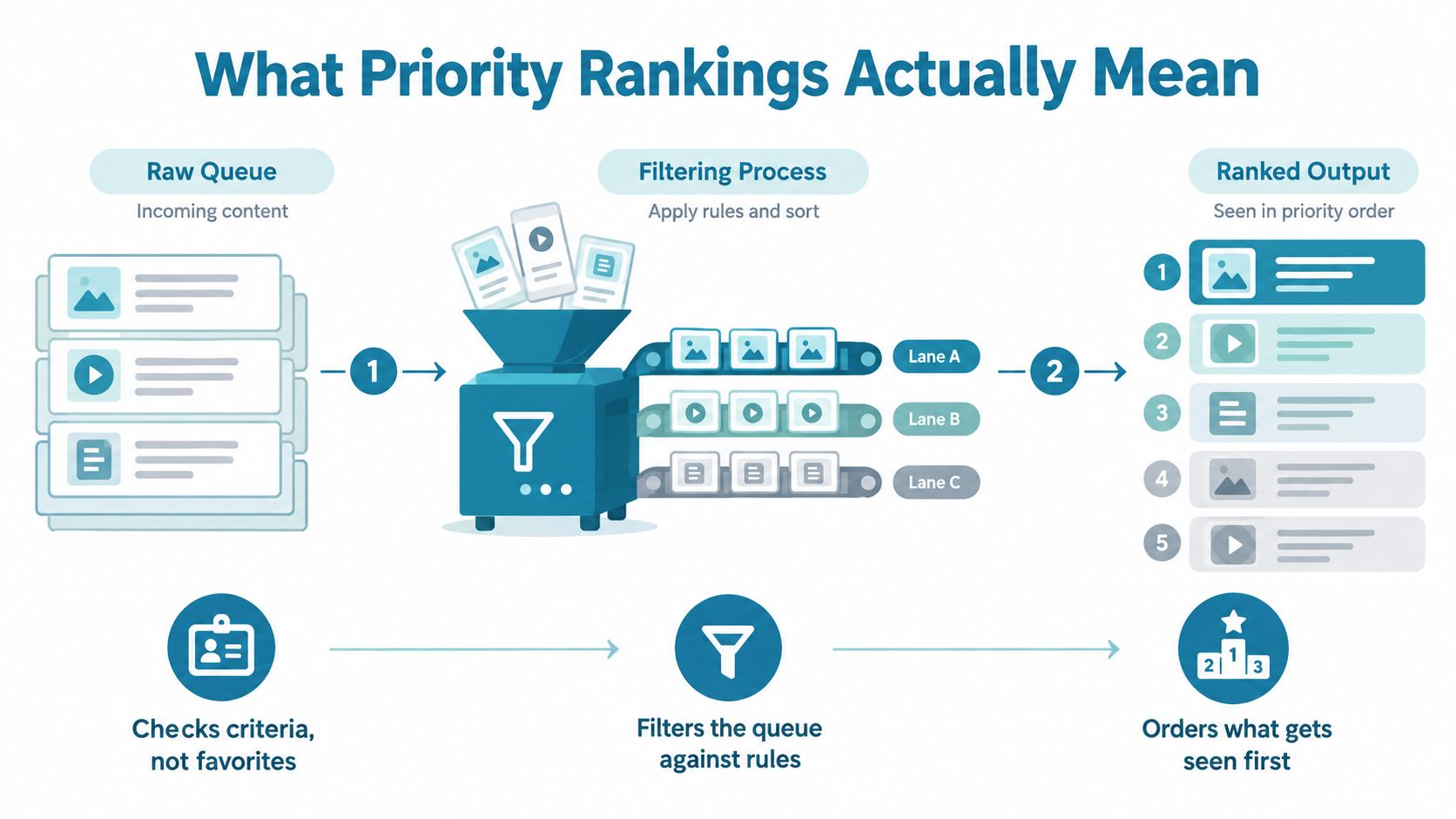
A simple analogy helps. Imagine a bouncer at a crowded club. The bouncer isn't personally choosing favorite guests. They're checking whether each person meets the entry criteria, then managing a queue when more people want access than the venue can handle.
Priority rankings work in a similar way. They help a system filter eligible options and order them according to defined criteria. In professional sport, the PGA TOUR's Korn Ferry Tour uses a priority ranking to determine which conditional members gain access to tournament fields. The ranking is rebuilt at the beginning of each season and reshuffled periodically as performance data changes, so a player's relative position can rise or fall during the year. The PGA TOUR's priority-rankings explanation describes how this ranking affects access to weekly fields.
Conservation offers another example. The Zoological Society of London's EDGE framework, launched in 2007, combined evolutionary distinctiveness with extinction risk to create ordered lists of species requiring priority attention. The approach focused on threatened species and converted two dimensions of importance into a practical ranking for conservation decisions. The later EDGE2 protocol described the method as a system established 16 years earlier, demonstrating how a priority ladder can remain useful across changing operational needs. The EDGE2 research article documents that history and purpose.
LinkedIn's feed applies the same general logic to content, but the ranking is personalized.
The two passes behind the feed
LinkedIn's 2026 feed architecture uses a two-pass retrieval-and-ranking pipeline. The first pass retrieves candidate posts from network and out-of-network sources. The second pass scores those candidates with a lightweight ensemble designed around a joint click-and-contribution objective, reducing tens of thousands of records to a few hundred for final ranking. LinkedIn's 2026 feed architecture document explains this retrieval and ranking process.
The distinction matters because a post can lose visibility before its final feed position is calculated. If early evidence suggests that a post isn't relevant or isn't generating useful interaction, it may not survive candidate retrieval for as many viewers. Strong early signals can help a post remain in the pool, but that isn't the same as guaranteeing a high position.
Priority is also relative, not absolute. LinkedIn isn't assigning every post a permanent public score that applies equally to everyone. It ranks eligible content for an individual viewer's session, based on that person's network, interests, professional context, and the other content available at that moment.
That's why the same post can perform differently for two similar accounts. Their audiences may overlap, but their relationships, recent behavior, and content history aren't identical. Ranking answers a practical question: which post should this particular person see next?
The Signals That Move Posts Up or Down
The feed doesn't treat every interaction as equal evidence. A quick reaction shows some response, but a sustained read or meaningful contribution can tell the system more about whether the post deserves continued distribution.
LinkedIn engineering has explicitly described dwell time as a negative ranking signal. Short dwell predicts lower-quality attention and weaker member satisfaction, while passive reading behavior provides broader coverage than explicit likes or comments. A rapid scroll-past can therefore hurt a post even when the post receives visible reactions. LinkedIn's engineering discussion of dwell time explains why the platform uses reading behavior to improve feed quality.
Positive evidence is about depth
Meaningful comments, saves, and shares that include commentary can provide stronger evidence of value than a stream of low-context reactions. A comment that starts a real exchange gives the system more information than a reaction that ends the interaction immediately. A save suggests that the reader may want to return to the idea, while a thoughtful share with commentary adds context for a new audience.
LinkedIn's ranking guidance also emphasizes relevance, expertise, and engagement quality rather than a single engagement metric. That changes the creator's question from “How do I get more likes?” to “What behavior would show that this post helped the right professional audience?”
Here's a practical comparison:
| Signal | Direction | Relative weight | Why it matters |
|---|---|---|---|
| Sustained reading, or dwell time | Positive when attention lasts, negative when it is very short | Strong | Shows whether the post earns continued attention |
| Meaningful comments and replies | Positive | Strong | Indicates contribution and conversation rather than passive approval |
| Saves | Positive | Strong | Suggests practical value or intent to revisit |
| Shares with commentary | Positive | Supportive | Adds context and can expose the post to relevant audiences |
| Clicks and reactions | Potentially positive | Context-dependent | Provide response evidence, but don't fully explain engagement quality |
| Rapid scroll-pasts | Negative | Strong | Suggest that the opening or relevance missed the reader |
| Superficial reactions without discussion | Limited | Weaker alone | Volume doesn't necessarily demonstrate usefulness |
You can test how a draft might read against these principles with a LinkedIn algorithm simulator, but no simulator can replace observing your own audience. The useful output is not a magic score. It's a prompt to ask whether the post is clear, relevant, readable, and capable of generating a genuine response.
The central trade-off is simple. Ten thoughtful contributions can be more informative than fifty automatic reactions. The exact volume matters less than what the interactions reveal about attention and professional relevance.
Why First-Hour Likes Are Not the Whole Story
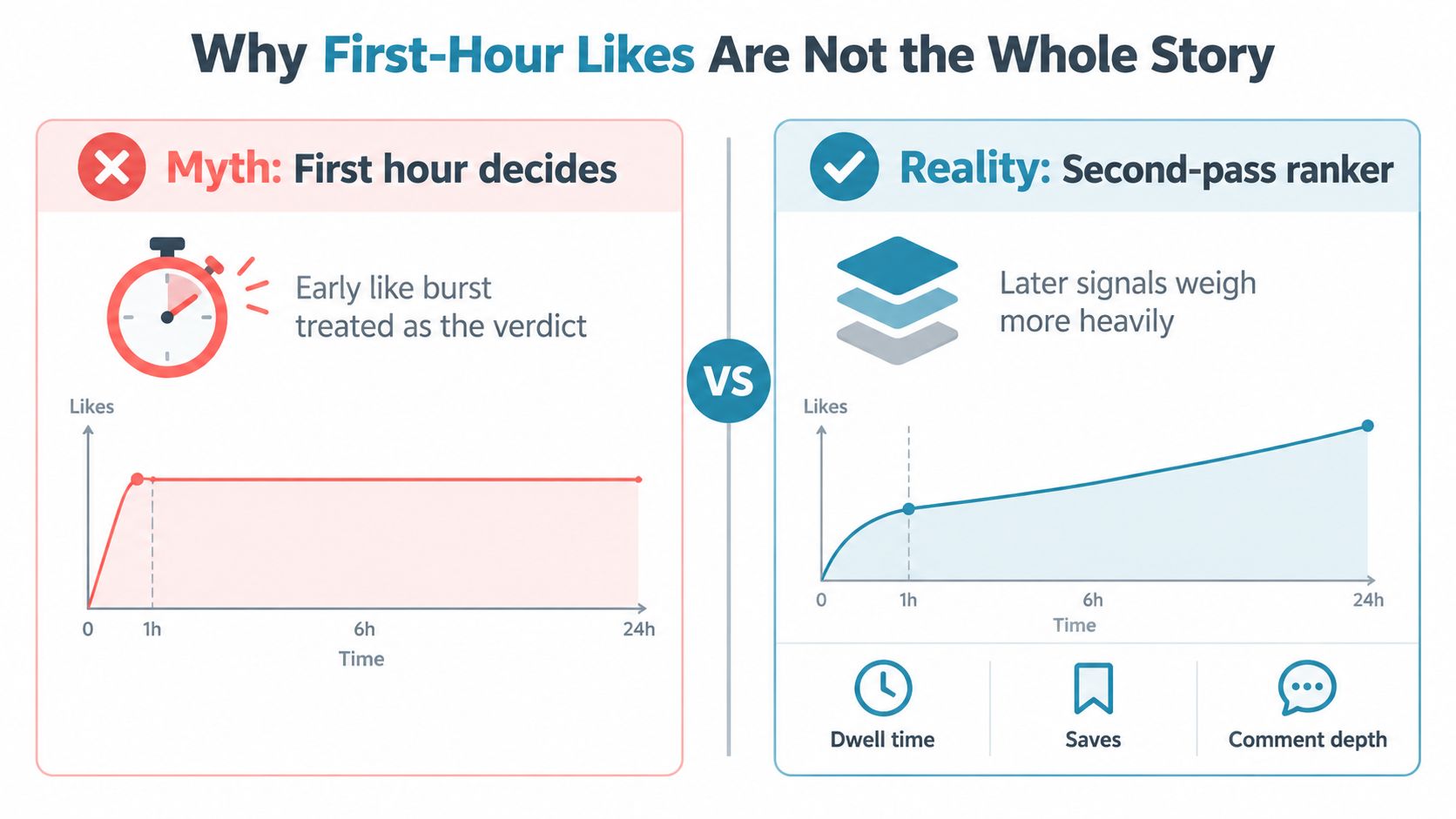
The popular first-hour story is easy to remember: publish, collect a burst of likes and comments, and either win distribution or lose it. That advice captures one part of the process, because early positive signals can affect whether a post remains in the candidate pool. It misses the deeper ranking work that happens when people read, save, discuss, and share the content.
LinkedIn's two-pass architecture creates an important distinction. Early activity can help retrieval, but the later ranking stage evaluates the quality of the available evidence. A reaction burst from the author's closest network may show immediate familiarity, yet it may say little about whether the post matters to people outside that circle.
Dwell time changes the interpretation
Suppose a post receives quick reactions from familiar contacts, but most readers scroll away after seeing the opening. The visible engagement may look encouraging, while the short dwell pattern tells the ranking system that the content isn't holding attention.
Now consider a different post. It receives a modest initial response, but readers spend time with the argument, save it for later, and add specific comments that lead to replies. That post may provide stronger evidence of usefulness even without a dramatic opening burst.
The distinction is supported by LinkedIn's own description of dwell time. The platform uses short reading behavior as a negative signal because it can predict lower-quality attention and weaker member satisfaction. LinkedIn's feed ranking guidance also places broader emphasis on relevance, expertise, saves, meaningful comments, dwell time, and shares with commentary.
A slow-burn example
Imagine publishing a post about a specialized sales problem. During the initial period, only a few close contacts respond. Later, the post reaches professionals who recognize the problem, read the full argument, and add detailed experiences in the comments. Those interactions give the ranking system richer evidence than the first reactions did.
That doesn't mean every post will suddenly revive. It means creators shouldn't judge performance through one early metric alone. Use LinkedIn analytics tools to compare attention and interaction patterns over time, then examine which topics and openings create sustained reading.
The more useful question is not “Did I get enough likes immediately?” It's “Did the people who saw this find a reason to stay, save, contribute, or share it with context?” A LinkedIn best-time-to-post guide may help with scheduling, but timing can't compensate for an opening that causes rapid scrolling or a topic that doesn't match the audience.
How to Tune Your Content for Better Rankings
A post can look successful in its first few minutes, then fade before reaching the people most likely to value it. LinkedIn's two-pass process helps explain why. The first pass tests whether the post is clear, relevant, and worth showing to a broader audience. The second weighs how people respond, including whether they read, contribute, save, or leave quickly. Tune the post for both stages.
What to post
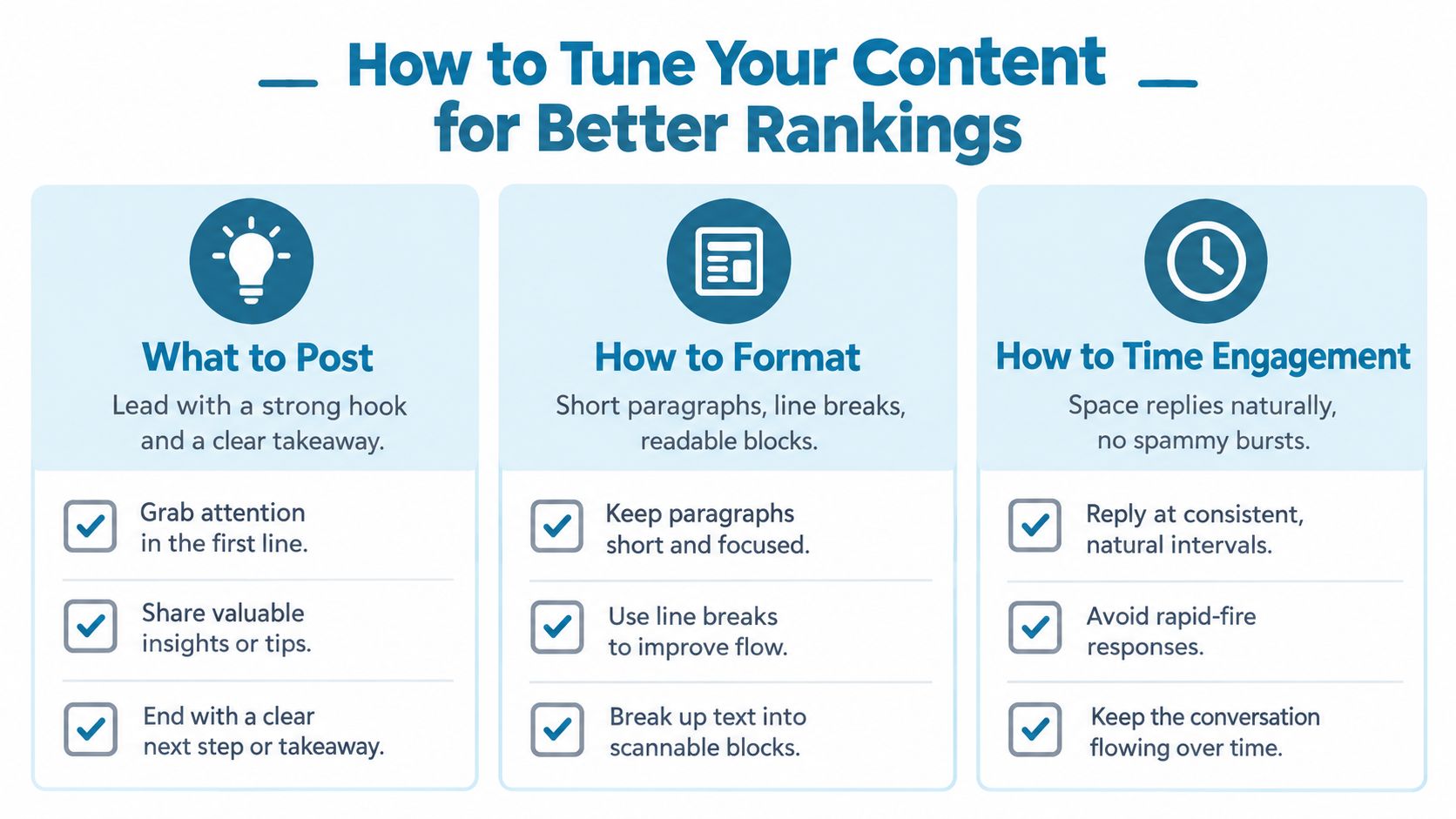
Start with one specific claim, tension, or observation. “LinkedIn reach is falling” gives readers little direction. “A post can receive reactions and still lose distribution if readers leave quickly” creates a clear reason to continue.
A strong opening helps the system classify the topic and gives the reader a reason to stay. Lead with one idea, support it with a concrete example, and end with a takeaway that a professional can apply. Each part should answer the reader's next question rather than add a second argument.
Dwell time needs careful interpretation. A long pause can indicate attention, while a quick exit signals that the opening, topic, or format failed to meet expectations. In that sense, dwell time can work as a negative signal when readers stop almost immediately. Make the promise in the first line match the value that follows.
Requests such as “like this if you agree” or “tag ten colleagues” can create activity without showing expertise. Coordinated engagement only supports a post when the responses are specific, relevant, and connected to its subject. Contribution quality gives the discussion more value than raw reaction volume.
How to format it
Readable structure protects attention. Use short paragraphs, deliberate line breaks, and one core idea instead of placing several arguments in a dense block.
Make expertise visible without making the post difficult to enter. Explain specialist terms in plain language, introduce an example before an abstraction, and provide enough context for the reader to understand why the point matters. Clear writing helps the retrieval pass find an appropriate audience and gives the ranking pass better conditions for sustained reading.
How to handle engagement
Respond to comments when the reply adds information. Ask for a relevant example, clarify a difficult point, or extend the original argument into a useful exchange. Before publishing, run the draft through a LinkedIn post analyzer to check its clarity and structure against these signals.
Use this check:
- Opening: Does the first line make a specific promise or claim?
- Readability: Can readers follow the argument without fighting a dense text block?
- Relevance: Is it clear which professional audience should care?
- Contribution: Can someone add an experience, question, or disagreement?
- Reusability: Would a reader save the post for later?
These choices give both ranking passes stronger evidence and protect your credibility beyond any temporary spike in low-context activity.
Matching Format and Audience to the Algorithm
There isn't one universally superior LinkedIn format. The strongest choice depends on the behavior you want to encourage and the audience you're trying to reach.
Text posts can work well when the subject benefits from personal stakes, a clear narrative, or a carefully developed argument. Their advantage is not automatic. The writing still has to earn sustained attention, and the topic must match the reader's professional interests.
Document carousels and image posts can make dense ideas easier to scan and save. They suit frameworks, checklists, visual comparisons, and step-by-step explanations. A reader who wants a reusable reference may respond differently from someone browsing for a personal story.
Native video creates a different attention pattern. Watch-through can matter more than a quick reaction, so the opening seconds, pacing, captions, and clarity of the spoken point all affect whether viewers continue. Polls may attract responses, but a high response count doesn't automatically mean the discussion has depth.
| Format | Strongest ranking signal | Best audience condition |
|---|---|---|
| Text post | Sustained reading and meaningful replies | Readers who value narrative, opinion, or professional analysis |
| Document carousel | Saves and completion of the sequence | Audiences looking for a reusable framework or visual guide |
| Image post | Attention and contextual discussion | Topics that benefit from a clear visual summary |
| Native video | Continued viewing and contribution | Audiences willing to learn through demonstrations or explanation |
| Poll | Comment depth and follow-up discussion | Communities with a specific question worth debating |
Language changes the result as well. Native-language relevance can improve the match between a post and the professional audience most likely to understand it. Plain-language hooks may broaden the retrieval pool, while jargon-heavy openings can narrow the audience before the post receives enough evidence to travel further.
Market maturity matters, too. In one audience, readers may prefer a detailed text argument. In another, a concise document may earn more saves because professionals are skimming for practical references. Test the format against the behavior you want, rather than assuming reach alone defines success.
For teams managing several markets, Sift AI enterprise LinkedIn tips can provide another perspective on adapting LinkedIn publishing practices to business audiences. The key principle remains the same: match format, language, and expertise to the people you want to serve.
Building a Feedback Loop That Compounds
Treat every post as a working hypothesis. You're testing a topic, an opening, a format, and an audience match, then using the resulting behavior to improve the next draft.
Review performance within 72 hours, focusing on dwell time, save rate, and comment depth rather than relying on reactions alone. The point isn't to hunt for a single winning formula. It's to identify which parts of the post held attention and which parts caused readers to leave.
Keep three simple habits:
- Build a swipe file: Save posts that appear to hold attention, then study their openings, structure, examples, and conversation prompts.
- Track signal patterns: Use a simple sheet to record the topic, format, audience, reading behavior, saves, and quality of replies.
- Review audience segments: Revisit which professional groups respond most usefully and adjust your examples and language accordingly.
A post that underperforms can still teach you something. Perhaps the subject was relevant but the opening was vague. Perhaps the format made the idea hard to scan. Perhaps the audience understood the point but had no natural way to contribute.
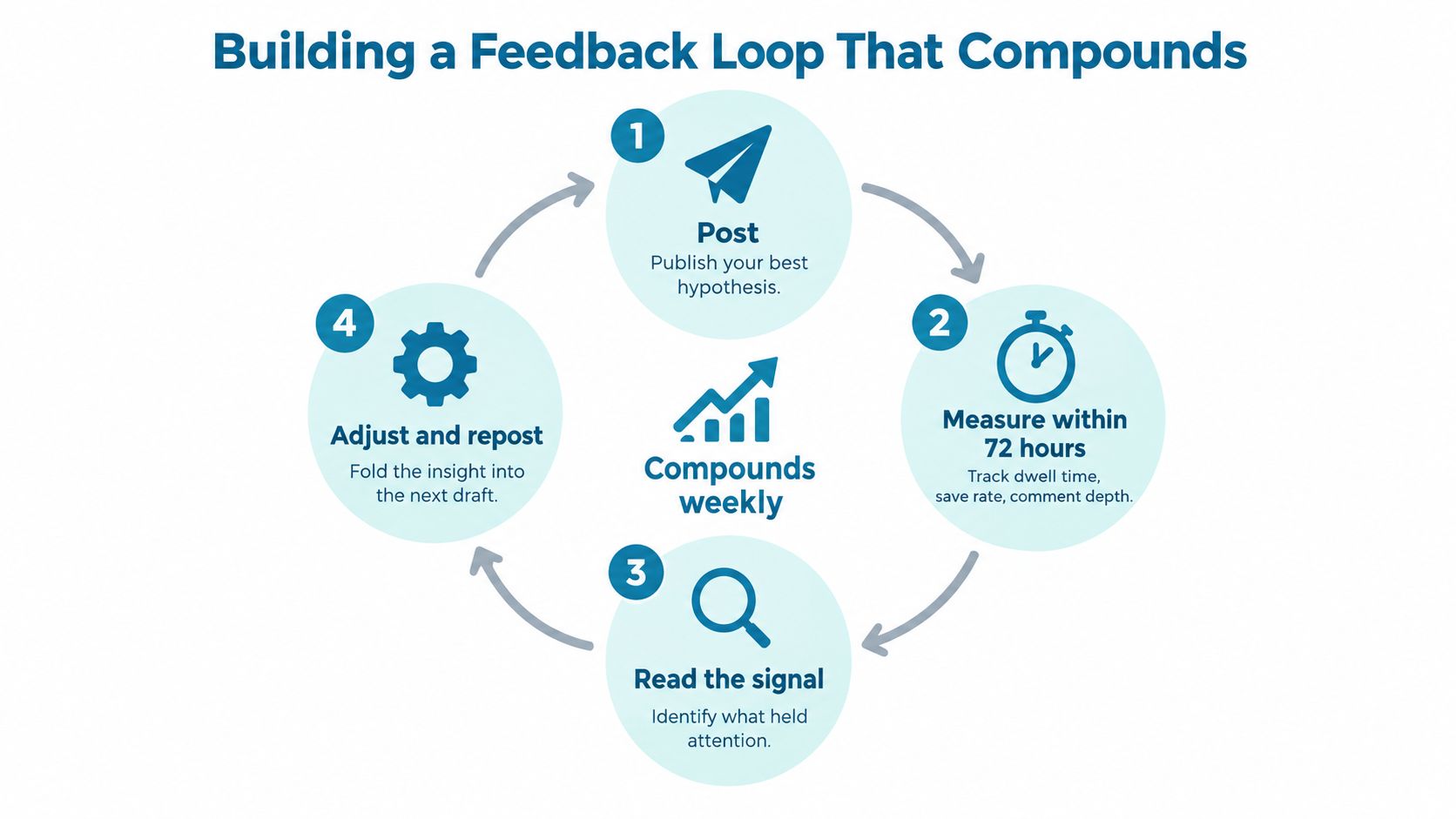
The creators who build durable LinkedIn distribution don't treat each post as an isolated verdict. They publish, measure attention, read the quality of the response, and carry the insight into the next piece. Priority rankings become easier to work with when every result improves your next decision.
Linkboost helps LinkedIn creators coordinate discovery, engagement, AI-assisted comments, pod management, and post analytics in one workflow. Use its reporting to connect early distribution activity with the deeper signals discussed here, then visit Linkboost to see whether it fits your publishing process.